Regionally Based
Assessment of Persistent
Toxic Substances
GEF
1st Regional Team Meeting
Southeast Asia and South Pacific
Manila, 5-7 June 2001
Minutes
===================================================================
Present:
Paul Whylie
- Project Manager
Gil Jacinto
- Regional Coordinator, South East Asia and South Pacific
Md. Sani Ibrahim
- Malaysia
Desley William Connell
Australia
Lim Kew Leong
- Singapore
1.
Opening Remarks & Introductions Dr. Rhodora V. Azanza, Dean, College of
Science, University of the Philippines, Diliman
Dr. Rhodora Azanza, welcomed the participants to the meeting and to the University. She
expressed the interest and desire of the University to actively participate in the fruitful
implementation of the project.
Dr. Nemesio A. Montano, President of the Marine Environment and Resources Foundation,
Inc., also expressed support of the Foundation in providing administrative support for
activities in the region.
Both officials wished all a successful meeting. Introductions were made by members of the
Regional Team and by Paul Whylie, the Project Manager (PM).
1
2.
Overview of Project
Paul Whylie gave an overview of the project. Key points mentioned included:
· The important role of the Regional Team (RT) for the successful implementation
of the project.
· The mechanisms for data acquisition and the preparation of the regional reports.
· The need for the Regional Team (RT) to short-list chemicals specific to each
region
· Transboundary modeling to be the responsibility of the regions
3.
Objectives, Workplan and the Timetable
The RT endorsed the objectives of the project. The workplan and timetable for the region was
discussed and accepted by the RT. The major revision to the original workplan was the
change of the completion dates for specific activities to what was considered a more realistic
timetable. The venues of the workshops and subsequent team meetings were generally
countries from where the regional team members came from. A summary of the workplan is
provided in Annexes A and B.
It was approved that a regional meeting be held outside of the base of the RC or the RT to
allow broader input from around the region. It was mentioned that the chapter on capacity
and root causes should be developed before the second regional team meeting when the first
draft of the regional report is discussed. The PM informed the meeting that the intention was
to include the RCs in the development of the global report. Therefore, their involvement did
not end when the regional report was completed. Regarding the early promotion of the
project, the PM was to send brochures to the RC for distribution within the region.
Other matters discussed included:
· `Data gathering´ line of budget provides an area of flexibility within the budget for
the RCs
· All invoices and record of expenditures should be kept for presentation. Forms
provided within the annexes of the contracts must be adhered to when making
reports
· List of country experts is dynamic; RCs can add names by informing Geneva
4.
Terms of reference for the Regional Team
The following points were highlighted during the discussion of the RTs:
· The RT members will have to take responsibility for certain countries within each
region that are not represented on the RT. Specifically, it was agreed that the team
2
members will contact appropriate persons and agencies in their own countries as
well as those countries not represented in the regional team as follows: Des
Connell (Australia, New Zealand, Papua New Guinea); Md. Sani Ibrahim
(Malaysia, Indonesia, Brunei Darussalam); Gil Jacinto (Philippines, Vietnam,
Cambodia, Laos); Lim Kew Leong (Singapore, Thailand). The RC was to identify
and invite a 5th member to the team from Vietnam to strengthen the data
collection and assessment phase.
· Payment of members of the RTs should be done upon attendance at RT meetings
· The proposed venues and schedules of the RTM are as follows:
o
2nd Regional Team Meeting - Vietnam or the Philippines, June 2002
o
3rd Regional Team Meeting - Australia, 4-6 September 2002
5.
The RBA PTS Website
The website was presented by the PM. It was agreed that the website should remain as
simple as possible to allow easy access by users with slower computers. It was also noted that
the list of experts from the region are relatively new and needs to be updated. The team
members were urged to update the information, especially from their respective countries and
to use as starting point the directory generated by the POPS project.
Regarding the Information Management System component of the website, it was noted that
there may be difficulty in urging participants/respondents to complete the questionnaires
through the web, especially if this were to be done by those from developing countries. Issues
include slow internet access as well as online time charges. This was particularly apparent in
downloading grid maps of the regions and sub-sites within regions.
6. Questionnaires
The 12 questionnaires on sources, environmental concentrations, and effects were examined
in detail.
It was felt that it would be useful to be able to feed PTS data to the GIS system through other
means besides the questionnaires. Aside from the completion of hard copies of the
questionnaire or providing information through the web, it was suggested that a CD-based set
of forms might be made available to respondents. The PM was to request the IMS consultants
to look into this. Team member, Sani Ibrahim, also offered to put together and make
available a set of electronic forms that would work on the Microsoft Access platform.
This list should be surveyed among the RT and short-listed for the contribution phase. It was
noted however, that a shortlist does not exclude the acceptance of data on other substances.
There were many other points that were discussed and decisions made to improve the
questionnaires.
3
7.
Technical and Priority Setting Workshops
The structure effectiveness and implementation of the workshops as well as venues of the
workshops were discussed. The following conclusions were drawn:
· The Technical Workshop (TW) could be completed in 4-5 days with a minimum
of 14 participants from the region, excluding the regional team members.
· The proposed venues and dates for the technical workshops are as follows (Annex
B):
! Workshop on sources and environmental concentrations, Singapore, 19-22 Feb
2002
! Workshop on impact and transport, Penang, Malaysia, 16-19 April 2002
! Regional Priority Setting Meeting, Bangkok, 16-19 July 2002
· Papers and reports can be published separately with the necessary
acknowledgements
· Much use should be made of the PDF-B workshop report that provides useful
background information on PTS issues.
· A sample format will be developed by the PM to harmonize workshops between
regions
· 3-4 expert presentations will be made at the TW meeting within the headings of
the regional report or as overview (regional outlook) papers to enhance the writing
of the report. These, along with the paper developed from the data contributed,
will form the basis for the regional report
· Countries are to be informed in advance of the RPSW and asked to nominate
appropriate representatives to send to the meeting
In general, the conditions for the workshops as laid out in the project document were
accepted. The nature of the expert papers to be delivered at the TW and the selection of the
experts were discussed. The process of selection for these experts should, as much as
possible, be transparent and would include a call for papers and an objective selection made
from abstracts received. However, given that the key experts in the region are generally
known by the RT, the decision will also be largely rest on the RT.
8.
The Regional Report
These decisions were taken after discussion on the outline of the regional report:
· The Introduction, Regional Capacity Needs, and Summary sections will be
handled by Gil Jacinto
· The sections on Transboundary Movement and Impacts will be handled by Des
Connell.
· The section on Sources will be handled by Kew Leong Lim
· The section on Cncentrations will be handled by Sani Ibrahim.
· The introduction should follow a standard pattern for all 12 reports. The reports
of the Arctic and Antarctic regions will serve as a guide for the other introductions
· References are to be added to the report
· A reminder was made for the RTs to be watchful for duplication of information
while analysing data for inclusion in the regional report
4
· The regional report should be approximately 100 pages long
The RTs were invited to make use of the PDF-B Workshops report to get a broad picture of
PTS substances and the issues that would arise.
9. Adjournment
In summary, the PM expressed satisfaction with the production of the meeting and felt the
stage was set for implementation and eventually a successful completion. He thanked the
RTMs for their participation in the meeting and wished all a safe journey home. The meeting
adjourned at 1500H, 7 June 2001.
5
ANNEX A
Updated Workplan for Region 8: Summary of Project Activities, Responsible Persons
and Products
Time
Responsible
Results
Activity
period
unit
Component 1: Co-ordination and management
1.1 Regional Co-ordinators´ meeting
Feb 2001
Project Manager
Review and finalise implementation of workplan. Familiarise with database.
and Co-ordinators Review and endorsement of questionnaires. Presentation of Regional
Teams. Troubleshoot
1.2 Establishment of project network
October 2000 Project Manager
Functional network of participants from different sectors of society in all
July 2001
and Regional
regions. Core team to attract suitable persons to network
Teams (Core
team)
1.3 Evaluation and reports to UNEP
May 2001-
Regional Co-
Six-monthly Reports and Final Budget and Evaluation Reports in
August 2002
ordinator
UNEP dictated formats
Component 2: The regional assessments
3.1 Country level contributions phase
June 2001-
Core team
Assembled data on PTS from all countries involved in the project
December
2001
3.2 1st Regional Team Meeting
June 2001
Core team
Meeting reports; Agreement on development of report; Team members
includes the 4 members of the Regional
responsibilities established
Team and the RC
3.3 Workshop on sources and
19-22 Feb
Core team plus
Workshop report on sources, levels, impacts and transport in the region
environmental concentrations 5 days
2002
experts
Draft chapters for regional report
duration with minimum 14 invited
Singapore
persons participating from the region
6
3.4 Workshop on impact and transport
16-19 April
Core team plus
Workshop report on sources, levels, impacts and transport in the region
5 days duration with minimum 14 invited
Penang,
experts
Draft chapters for regional report
persons participating from the region
Malaysia
3.5. Assessment of regional capacity and
November
Core team
Draft chapter for regional report
needs to manage PTS and the root causes
2001-March
of the problems
2002
3.6 2nd Regional Team Meeting
June 2002
Core team
Consensus developed on the first draft report for each region
includes the 4 members of the Regional
Philippines
Team and the RC
or Vietnam
3.7 Regional Priority Setting Meeting 5
16-19 July
Core team
List of regional priorities for regional report
days duration with minimum 30 invited
2002
persons participating from the region
Bangkok ?
3.8 3rd Regional Team Meeting
4-6 Sept 2002 Core Team
Consensus developed on the 2nd draft report for each region
includes the 4 members of the Regional
Australia
Team and the RC
3.9 Final editing and review of Regional
Sept-Oct
Core team
Regional Report for each region
Report
2002
3.10 Print report.
Nov 2002
Core team.
Copies of Regional Report distributed as specified. Includes a
Printing
copy for each country in the region, for each member of the team
specifications to
and 10 copies for GEF/UNEP. Three copies of the Report to be
be dictated by
Project Manager
made available on CD Rom to UNEP
7
ANNEX B
Regionally Based Assessment of Persistent Toxic Substances Project
Activities of Region 8 Team Members
PERSON(S) RESPONSIBLE
DES KEW
LEONG SANI
GIL
TASK
CONNELL LIM IBRAHIM
JACINTO
1
Country Coordination Australia, New
Philippines,
Malaysia,
Zealand,
Singapore,
Vietnam,
Brunei,
Papua New
Thailand
Cambodia,
* Questionnaires
Indonesia
Guinea
Laos
* Network members
* Promotion
Introduction,
Trans-
Regional
Concentra-
2
boundary
Regional Report Sections
Sources
Capacity,
movement,
tions
Needs,
Impacts
Summary
3
Workshop 1 Coordinator,
Singapore
4
Workshop 2 Coordinator,
Penang, Malaysia
5
2nd Team Mtg, Vietnam
6
Regional Priority Setting
Meeting, Bangkok
7
Final Team Meeting,
Brisbane
8
Six-monthly reports
9
Workshop 1 Agenda
10
Workshop 2 Agenda
11
Regional Priority Setting
Meeting Agenda
12
Letterhead for Region
13
Database query needs
14
Mid-term assessment
Link with NGO umbrella
15
org/regional org
8
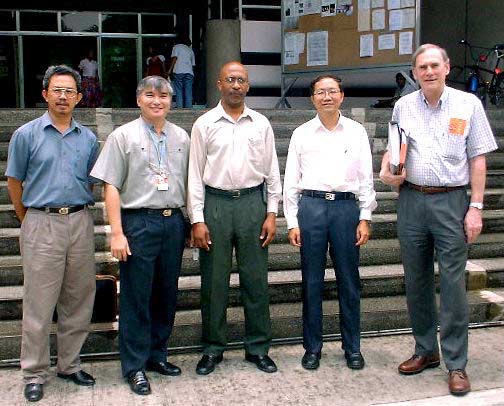
1st Regional Team Meeting, Region 8
University of the Philippines, Diliman, Quezon City
Philippines
5-7 June 2001
(L-R) Sani Ibrahim, Gil Jacinto (RC), Paul Whylie (PM),
Lim Kew Leong, and Des Connell
9
Document Outline